Backing research rising stars in Ireland
9 July 2026 / Lister News Blog

9 July 2026 / Lister News Blog
We’ve launched a new initiative to raise the Lister Institute's profile across the island of Ireland. The work aims to support high quality applications and greater representation from early-career biomedical researchers based in Ireland.
The Lister Institute's connection to Ireland traces right back to its origins. Joseph Lister, who helped establish the organisation, always saw science as a project to be supported across the nations of the British Isles, not as the property of any one country. Then Edward Cecil Guinness, 1st Earl of Iveagh, endowed the fledgling Institute with £250,000. Our links with Ireland were firmly and formally embraced.
Our UK-Ireland hybrid heritage frames an initiative that the Institute's Trustees have been quietly building over the past year. Professors Julian Blow (Trustee) and Anne Rosser (Chair, Scientific Committee) conducted a thorough review and horizon scan of the research landscape and funding in Ireland on behalf of our Governing Body. This study recognised a clear opportunity to raise the profile of and promote the Lister Prize award in Ireland and support eligible researchers to develop top quality Prize applications.
We listened carefully to the challenges universities and research institutions in Ireland face trying to support early-career researchers as they establish new research groups. And we realised there was much to celebrate about the Lister Institute's historical ties with Ireland.
These insights help to shape our new Ireland Initiative. “There’s a mismatch between the strength of biomedical research in Ireland and the number of Lister Prize Fellowships being awarded to researchers based there,” Julian explains. “Ireland has a vibrant and internationally competitive life sciences community, yet this is not fully reflected in our Fellowship portfolio. Our new initiative aims to address this.”
For the Hon Rory Guinness, current Trustee representing the Guinness family, this latest initiative is also one of remembering. “Lister’s strategy has always been about supporting brilliant people doing incredible science,” he says. “That will never change. The Lister’s founding Trustees, including the great surgeon himself, was to see science as not just a national project for one country, but as something that should be supported across the nations of the British Isles, from their universities to their institutes to their hospitals. The emphasis was always on amazing science and the incredible people that choose to make a difference to world through science. Just as the Lister's Trustees are supporting scientists in Ireland, so science in Ireland needs to celebrate the Lister.
“You can’t deny the Lister’s links to Ireland – through my family, through our interest in science in the Guinness brewery, to the purchase of the first microscope, to our understanding as brewers of the importance of fundamental research for commercial but also for societal benefit. For us, it all started in Dublin.”
Julian says that the Lister is re-engaging – strengthening historic ties and making sure that outstanding Irish-based researchers see the Lister Prize as something genuinely within their reach.
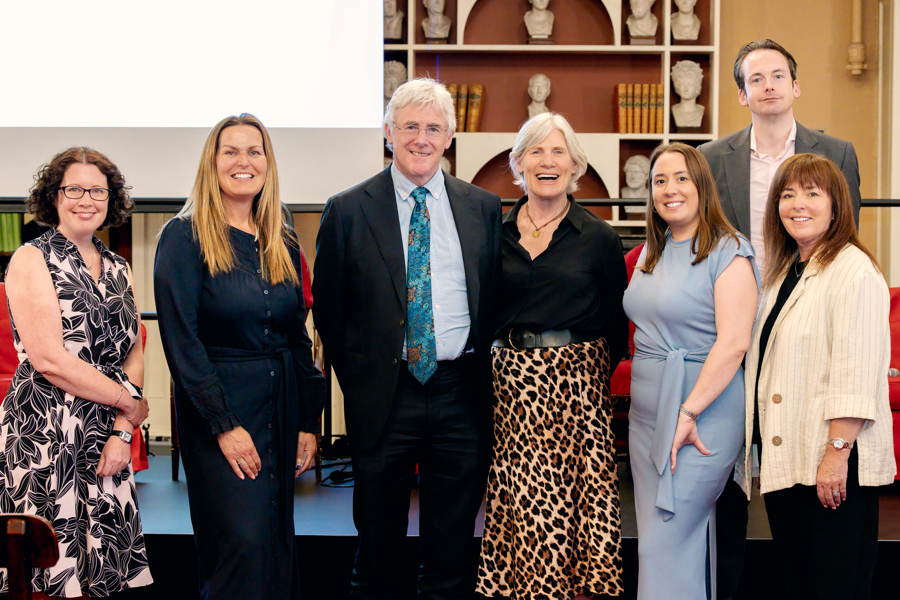
The initiative visibly launched on 3 June 2026 at the Royal Irish Academy in Dawson Street. Co-hosted by RIA Secretary for Science Professor Noel Lowndes, the Lister Ireland Research Synergy Event (LIRSE) brought current and former Fellows – Chris Hill (University of York), Lizzy Rosser (UCL), Aga Gambus (University of Birmingham), Rebecca Corrigan (University College Dublin) and Tomás Ryan (Trinity College Dublin) – into conversation with prospective applicants, research office staff and senior figures from institutions across Ireland.
The Dublin event demonstrated a strong appetite for engagement. Researchers were keen to understand the application process better, hear directly from Fellows, and get insights into how to shape their work into a compelling application. “That gives us real confidence that the demand is there,” remarks Julian. “It’s more a question of better connecting the dots.”
For Professor Cliona O'Farrelly of Trinity College Dublin, who sits on the Lister Scientific Committee and chaired the opening session, the day highlighted the enormous demands placed on academics – grants, papers, teaching, leadership, media – so that many struggle to develop and navigate the complexities of collaboration and competition. “Early-career researchers struggle to find time and head space to properly develop exciting and original concepts, ideas and technologies. There is little opportunity to share their new data and technologies with more experienced researchers in their institute or with other researchers across the island,” she observes. “If they have recently taken up an academic post in an Irish university, there often is pressure to deliver a teaching load and to supervise undergrad research projects. Very few of us seem to be able to just sit around and discuss our science with one another.”
“Also,” Cliona adds, “up to this year there has been little institutional knowledge or awareness amongst Irish universities about the Lister Institute, its mission and its support for excellent researchers across Great Britain and Ireland. The Lister Irish Research Synergy Event has changed that!”

The pre- and post-event survey gave a stark snapshot of our starting point. Some 73% of respondents had not heard of the Lister Prize before this year, and 87% did not realise that early-career researchers in Ireland were eligible to apply at all. By the close of the day, 100% reported a significant increase in their awareness – and, more tellingly, some attendees said they now intended to apply. Others wanted to seek mentorship from current and former Fellows, while some research office staff mentioned putting extra support in place for early-career researchers at their own institutions.
Anne Rosser also helped to demystify the Lister Prize application process. She describing how each application is assessed with scientific rigour, but that final selections are also made on where the Prize funding could help to transform an applicants research direction and career.
Professor Tomás Ryan from Trinity College Dublin won a Lister Prize in 2020. He wholeheartedly agrees with Cliona. “The Prize helps to protect individuals in a highly pressured system with flexible funding to support their bold ideas,” he says. “But that individual also becomes an agent for progressiveness in their country and in their institution, because it shows the wider community what we consider good research to be. It's not about loading young faculty with teaching loads and admin work, or delaying their progression until they're older, or forcing them to join the research programmes of senior faculty or thematic areas of their insitution. It's saying no, you should be independent, you should do what you want, provided you can produce internationally competitive original science. Early-career researchers are hungry to ask answer big questions; the Lister backs them and that's the energy we need to keep excellence going.”

In June 2026 we welcomed a new Fellow from Ireland to the Lister community. Dr Chris Greene, Star Research Lecturer in the Department of Physiology and Medical Physics and FutureNeuro Research Centre at RCSI University of Medicine and Health Sciences, is one of eight Lister Prize 2026 Fellows.
Chris's £300,000, five-year award will support a bold programme of research on the blood-brain barrier. When this barrier breaks down, material in the blood such as serum proteins can seep into the brain leading to hyperexcitability and neurodegeneration. With this prize, Chris and his team will investigate if differences in the patterning of the cerebral vasculature between hemispheres shapes the lateralisation of cognitive functions and if this is disrupted in schizophrenia.
“It's a privilege to receive this prize fund that will allow my group to answer fundamental questions that could redefine how we understand the very organisation of our brain and the development of psychiatric disorders,” says Chris. “It's a real honour to be able to connect with a diverse group of talented scientists across Ireland and the UK that will help to establish new collaborations to drive my vision forward.”
Read more about Chris's research and all the other Lister Prize 2026 winners.
This initiative is not about scale, however. “Our goal is not to increase the number of applications,” Julian explains. “What we want is more applications of the kind that the Lister Prize is designed to support: bold, original, and capable of reshaping a field. That’s why we’re encouraging mentoring and community-building, because it helps in three important ways. First, it demystifies the Prize. Second, mentors can strengthen the intellectual development of proposals. Third, it builds confidence – many outstanding early-career researchers underestimate their own competitiveness. A supportive community, particularly one that includes people who have been through the process, can give individuals the confidence to put forward their most ambitious ideas.”
Cliona is in no doubt about why peer-led mentoring is so powerful: “Lister Fellows can quickly spot whether an early-career researcher has the CV and proposal to be competitive. If they don't, Fellows have the empathy to communicate sensitively why they might try elsewhere; and if they do, Fellows have the experience, expertise and connections to help enhance and improve a proposal with relatively little effort.”
Speakers at the Dublin event helped to show what good mentoring and support look like in reality. Professor Aga Gambus's talked about her experience of the University of Birmingham's Fellowship Academy for Medicine and Health. It supports talented postdoctoral researchers to seek personal Fellowship awards, including MRC Career Development/Clinician Scientist Awards, NIHR Advanced Fellowships, UKRI Future Leaders Fellowships, equivalent Wellcome schemes, and ERC Starter Grants. The Academy offers pump-priming programmes alongside practical advice and guidance through grant clinics, bid building, interview preparation and post-award mentoring. The programme is delivering results: Lister Fellows Rebecca Drummond and Sarah Dimeloe feature as one of the Academy’s success stories.
Dr Rebecca Corrigan, a 2018 Lister Prize winner who returned to Ireland in 2024 to lead her group at University College Dublin, shared more about how the Lister Prize impacted her research and career, while a panel of current Lister Fellows shared their top tips for applying for a Lister Prize, for example:
Prepare your Lister Prize application at least six months in advance.
Get colleagues from neighbouring disciplines to read your application.
Look up the Scientific Committee and write your application for them.
Make sure your CV demonstrates that you can deliver and publish.
Negotiate with your host institution to underwrite your salary for the five years of the Fellowship.
Above all, said Rebecca, recognise what the Prize is really for. “Lister is investing in the people. You need to show how this Prize will forward your entire career and develop your lab – not just how it will answer one specific scientific question.”

So, what does success from this renewed attention on the research community in Ireland look like? Julian's answer is deliberately cultural rather than numerical. Yes, more high-quality applications; yes, more Fellows based in Ireland. But beyond the metrics, the ambition is “that the Lister Institute becomes more integrated into the natural landscape of biomedical research in Ireland”. He hopes for a visible, active network of Fellows and supporters acting as ambassadors, mentors and points of contact. Rebecca concurs: a larger community of Lister Fellows in Ireland would, she believes, drive increased quality of science through natural peer mentorship, increased grant capture and improved international recognition for the country.
For early-career biomedical researchers: the Lister Prize 2027 is now open for applications. Read the eligibility criteria, start a conversation with senior colleagues, and – as Cliona advises – “talk with at least one Lister Fellow” before you put pen to paper.
For current and former Fellows: reach out and offer to mentor a prospective applicant based in Ireland. A single conversation can be the difference between vague aspiration and a compelling, competitive application.
For institutional leaders and research offices: Learn about the Lister Prize, get insights from previous Prize winners and provide your rising stars with informed support – including, where you can, underwriting salary for the duration of the award.


