Every summer, the Lister Institute welcomes talented undergraduates into world-class laboratories to experience the excitement—and challenges—of biomedical research. Our 2025 cohort tackled questions spanning cancer biology, antimicrobial resistance and viral biophysics, gaining skills and insights that could shape their next steps.
Alyssa Tong
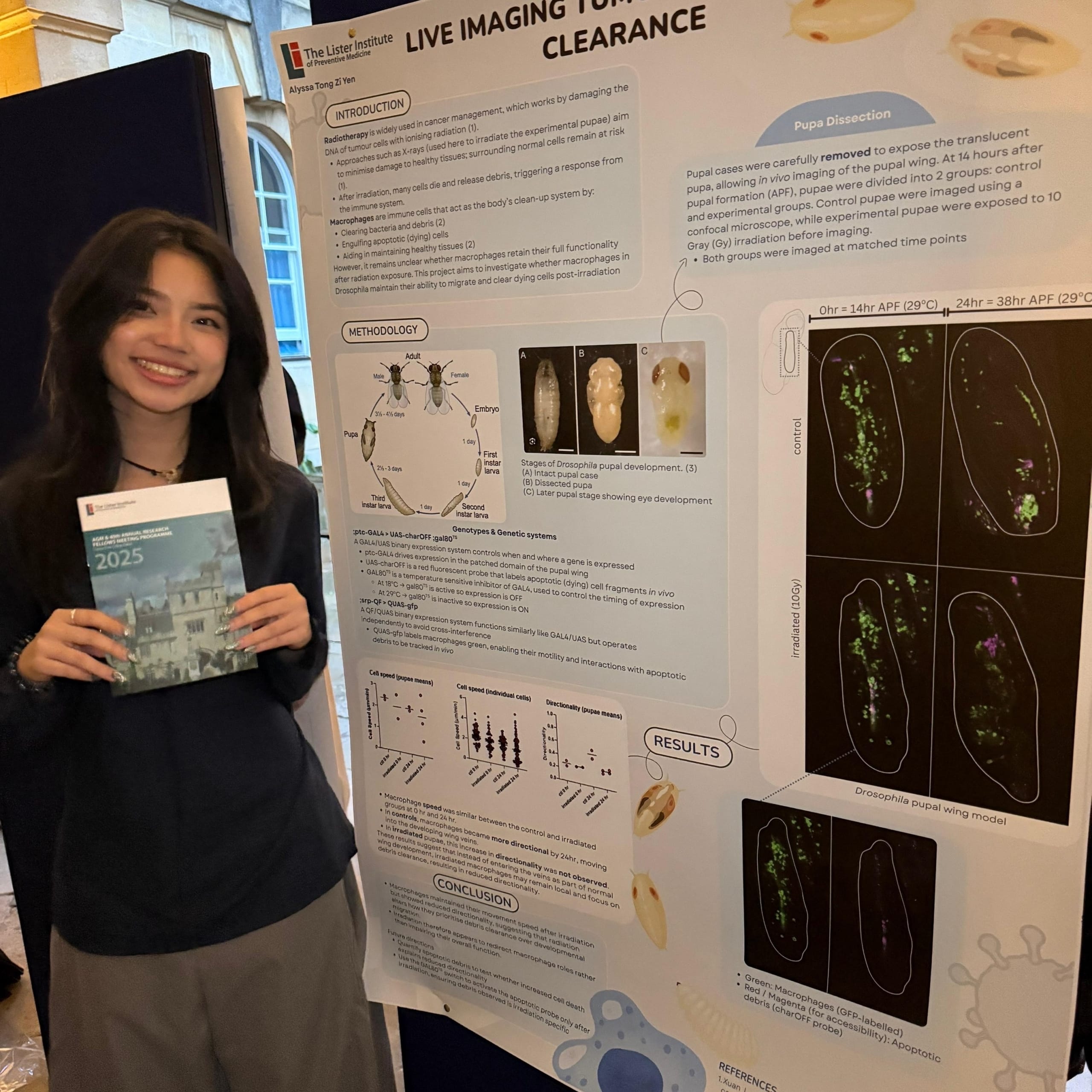
I wanted to gain hands-on laboratory experience in biomedical research and explore how research opens pathways to adeeper understanding of human disease.
When Alyssa first peered down the microscope in Dr Andrew Davidson’s lab at the University of Glasgow, she was about to witness something extraordinary. “Seeing those macrophages prioritise apoptotic debris clearance over developmental migration in real time was fascinating,” she recalls. The moment came after hours of delicate dissections—work that demanded patience and precision as she removed the Drosophila pupal case to reveal the delicate and translucent pupa for in vivo live imaging.
For Alyssa, the project has been transformative, confirming her passion for a research-focused career, giving her confidence to pursue postgraduate study. “Before this, I wasn’t particularly keen on pursuing a PhD, as I didn’t think I had the persistence required for it. However, I genuinely feel as though my perspective has now completely changed. This experience strengthened both my technical and analytical skills, and I gained confidence in voicing and communicating any challenges I faced. I really deepened my appreciation for the collaboration and problem-solving nature of research.”
Andrew adds: “Alyssa generated some very nice preliminary data, which is of great value for my lab’s research going forward.”
Project: Live-imaging tumour cell death and its clearance
Radiotherapy is a common cancer treatment that kills tumour cells through DNA damage; however, it may also affect surrounding healthy cells. After irradiation, many cells die and release debris, which is cleared up by macrophages to maintain tissue health. But do macrophages retain this functionality after radiation exposure? Using wings from Drosophila pupae as an in vivo model, the study investigated how irradiation influences macrophage migration and debris clearance during pupae development.
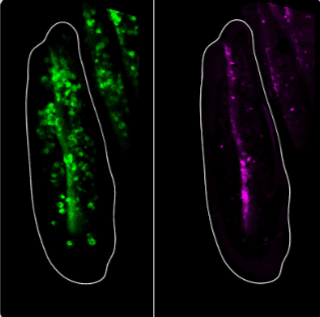
Key techniques
- Confocal microscopy
- Dissection
- Drosophila line generation
- Cell fluorescent labelling
Find out more about Andrew’s research when we chatted to him during a Lister Prize visit to the University of Glasgow.
Jamie Terry
Overall, the experience has strengthened my motivation to continue towards a PhD and potentially a future career in research.
At the start of his placement, Jamie Terry often felt uncertain. “I was asking frequent questions,” he admits. But six weeks later, he was confidently planning, setting up, and running experiments, troubleshooting and interpreting data. “The freedom I was given in the lab grew my confidence as an independent researcher,” he says—a turning point that made him feel like a real scientist. “The studentship bridged the gap between the classroom learning environment and the research environment allowing me to develop insights into what it might take to pursue a PhD or even an academic career in the future.”
Alexander Borodavka, Jamie’s supervisor, really noticed Jamie’s rapid progress too. “Jamie joined the lab with limited prior experience, but he quickly developed proficiency… He contributed meaningfully to our work, not only through his experimental efforts but also by bringing forward new ideas.”
Project: Investigating phosphorylation dependent regulation of viral condensates
Rotavirus is a leading cause of severe gastroenteritis, affecting millions of children worldwide each year. Viral replication relies on viroplasms—biomolecular condensates formed by the phase separation of the viral proteins NSP5 and NSP2. Alex tasked Jamie to investigate phosphorylation-dependent regulation of these condensates. Using phosphomimetic substitutions, Jamie showed that condensate size did not vary significantly with the overall number of substitutions. In contrast, the selective Ser67 mutant displayed reduced droplet growth, highlighting this site as a critical regulator.
Key techniques
- Cloning
- Protein purification
- Phosphorylation
- Droplet assays
Alex remembers trying to build an artificial heart prototype as a child. Find out how his fascination with biology has shaped his career.

Nia Feakes
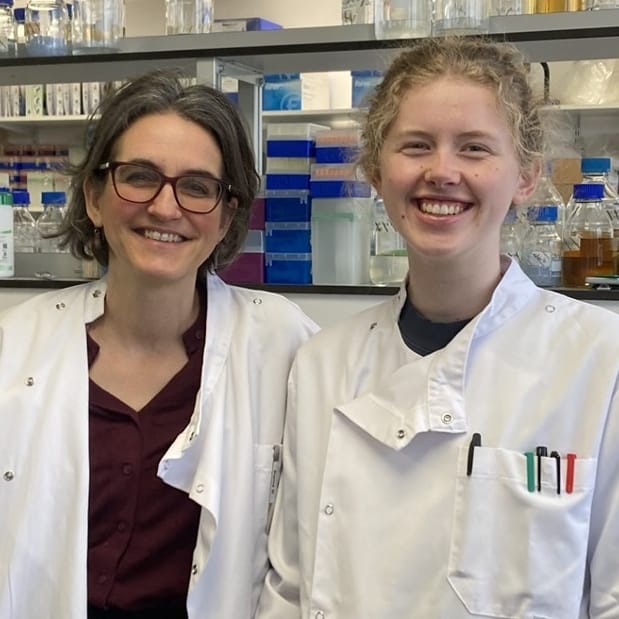
A supportive and friendly community makes all the difference in working productively, and the van Houte lab proved this. I looked forward to getting into work every day.
For Nia Feakes, the summer studentship was about more than learning new techniques—she wanted to find her place in science, too. “I wanted to experience biomedical research in a top laboratory and build on the techniques learnt during my degree in a meaningful way. I found the work of my supervisor inspiring and matched my desire to work in the field of antibiotic resistance and bacteriology. Working on CRISPR antimicrobials felt like being part of something that could really change how we fight infections.”
But it wasn’t just the world-class research that made Nia feel like she belonged. “I felt really welcomed, it’s a lovely laboratory group. A supportive and friendly community makes all the difference in working productively, and the van Houte lab proved this. I looked forward to getting into work every day. The support from my host laboratory and introduction to scientific conferences at the Lister AGM was instrumental to that experience.”
“Nia was an excellent and highly motivated student who made a significant contribution to the ongoing Klebsiella work as part of my Lister award. She picked up new skills swiftly and with confidence, and was an excellent colleague. We have a manuscript in preparation and Nia will be a co-author.” says Stineke van Houte. “Plus, we look forward to welcoming her back as a junior technician to expand the work she started.”
Project: Using CRISPR-Cas9 tools to block AMR plasmid transfer in Klebsiella pneumoniae
Klebsiella pneumoniae is a pathogen known for its virulence and capacity to transfer antimicrobial resistance genes via plasmids into the environment and neighbouring bacteria. This transfer is especially problematic in hospital environments and during open surgery. Nia investigated whether gene-specific CRISPR-Cas9 antimicrobials could be introduced into polymicrobial communities to stop antimicrobial resistance gene transfer.
Key techniques
- CRISPR-Cas9
- Bacterial culturing
- Plasmid uptake and conjugation analysis
Soon after her Lister Prize award in 2021 we sat down with Stineke to find out what it was like to apply for—and win—the Prize as a new parent and during a global pandemic.

Summer Studentships 2026: How to apply
Applications for the Summer Studentship 2026 scheme are now open.
If you’re an undergraduate keen to experience cutting-edge biomedical research, you must first make contact with a current or former Lister Fellow to discuss a project. You can contact as many Fellows as you wish, however we will only accept one studentship application per Fellow.
Fellows and former Fellows must submit a Summer Studentship application (using a private link provided by the Institute) before the deadline of 30 May. Studentships will be allocated to Fellows on a first come, first served basis. Successful student applications will be notified by the Fellow.
Find out more on our Summer Studentship pages.